SINGAPORE — 30 may 2026
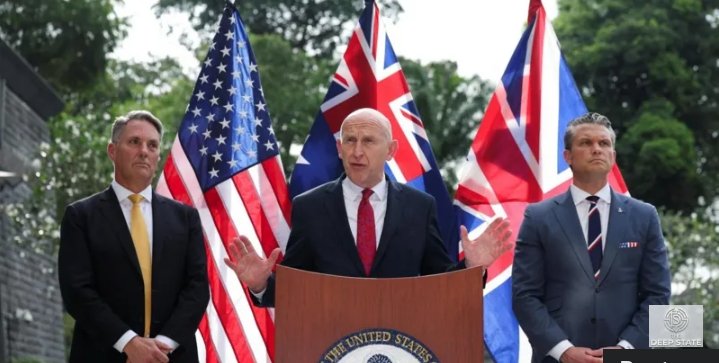
The United States, United Kingdom and Australia have announced a major new defense initiative under the AUKUS security partnership, unveiling plans to develop advanced underwater drone technology designed to protect critical undersea infrastructure and enhance military operations.
The announcement was made during the Shangri-La Dialogue security summit in Singapore, where defense leaders from the three nations revealed that the new uncrewed undersea vehicle (UUV) capability is expected to be operational by next year.
British Defence Secretary John Healey confirmed that the United Kingdom will contribute £150 million ($201 million) toward the project, describing it as a significant step forward for the alliance.
"For too long in AUKUS, we talked too much and delivered too little. That has now changed under our three governments," Healey said.
The UUV program represents the first major project under AUKUS Pillar Two, which focuses on advanced military technologies including artificial intelligence, hypersonic weapons, cyber capabilities, and undersea robotics.
According to a joint statement, the underwater drones will be equipped with cutting-edge payloads, sensors, and weapons systems capable of:
Protecting underwater cables and pipelines
Conducting surveillance and reconnaissance missions
Supporting logistics operations
Performing precision strike missions
Monitoring seabed infrastructure
Defense officials emphasized the growing importance of safeguarding underwater communications networks that support global internet traffic, energy supplies, and military communications.
The announcement comes amid increasing concerns over threats to undersea infrastructure. British officials have previously accused Russia of conducting covert activities near critical cables and pipelines in northern European waters, allegations denied by Moscow.
Similar concerns have emerged in Asia, where Chinese vessels have been linked by various governments and investigators to incidents involving damaged undersea cables near Taiwan and in parts of Northern Europe.
While the defense ministers declined to directly state whether the project targets Russian or Chinese activities, analysts view the initiative as part of broader efforts to counter growing strategic competition in both the Indo-Pacific and Atlantic regions.
Submarine Program Remains a Long-Term Goal
The underwater drone project arrives as AUKUS faces scrutiny over the pace of its flagship submarine program.
Under AUKUS Pillar One, Australia is scheduled to acquire nuclear-powered submarines with support from the United States and United Kingdom. However, the first new-generation submarines are not expected to enter service until the 2040s.
To bridge the gap, US and UK nuclear-powered submarines will rotate through Australian naval facilities, while Australia plans to purchase second-hand US submarines during the 2030s.
Australian Defence Minister Richard Marles reaffirmed Canberra's commitment to the submarine initiative, stating there is no alternative path available.
US Defense Secretary Pete Hegseth also confirmed that plans for submarine rotations remain on schedule, with the first US Navy personnel expected to arrive in Australia later this year.
Officials say the new underwater drone program could provide a faster and more flexible capability while larger submarine projects continue to develop.